
Free live workshop · 60 minutes
The Brand Prompt Workshop
How to Stop Your AI Images Looking Like Everyone Else's.
Build one reusable master prompt that makes every image you generate look like your brand, not like the internet’s average.
Live Webinars on first Saturdays at 10:00 AM Central, and third Wednesdays at 7:00 PM Central. Pick your date on the next screen.
the recognition
Your AI images are Not Bad. They are Interchangeable.
- Logo in the top left.
- Headline on the left with ONE word in a COLOR.
- Photo on the right.
- A row of small icons with labels underneath.
- A rounded button.
- A tagline bar across the bottom.
This is where most of these pages tell you that AI images look cheap. They do not, and you know they do not, because you have made some you were happy with.
Here is the actual problem. Put fifteen promotional graphics side by side from fifteen unrelated businesses. A law firm. A skincare line. A bookkeeper. A gym. Each one, on its own, looks fine.
Together they are one image.
Nobody chose that layout. It is what the tool produces when you describe what you want in a sentence.
And your reader is not comparing your image to a bad one. They are comparing it to the four other images they scrolled past in the same minute, and those four came out of the same average.
- INTERCHANGABLE GRAPHICS
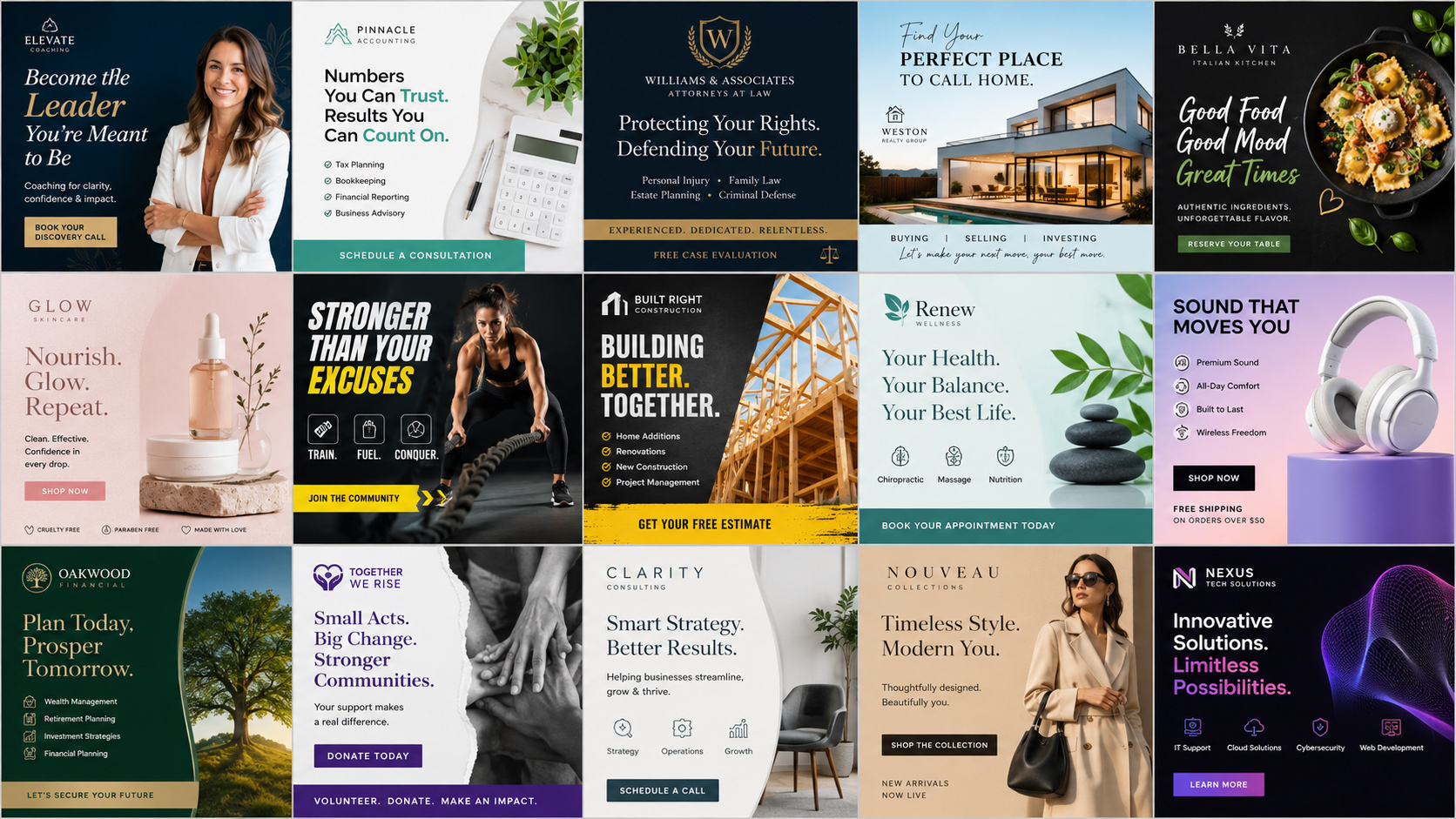
Described in a sentence. Fifteen businesses, one layout.
- SPECIFIED GRAPHICS
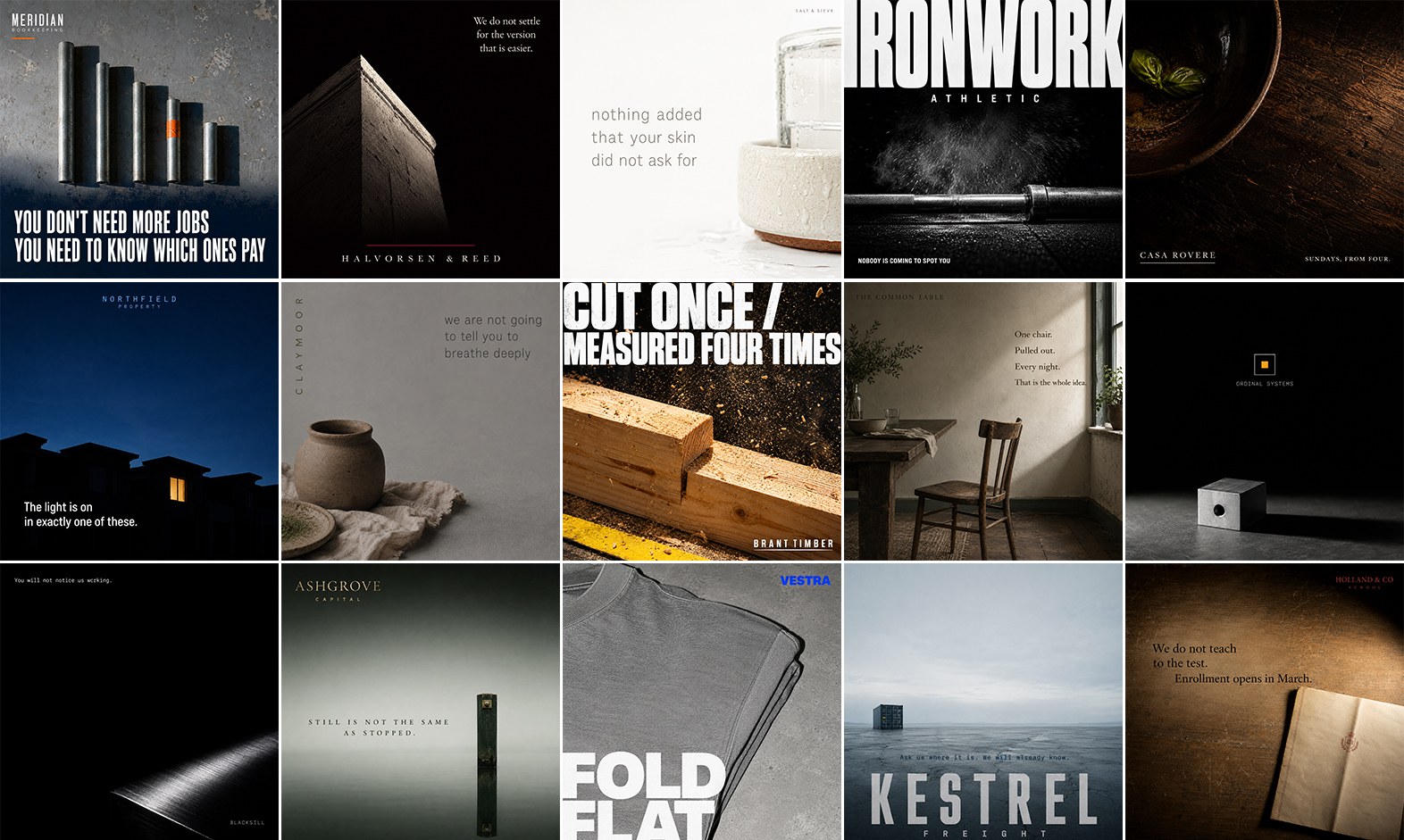
Built on a specification. Fifteen businesses, fifteen brands.
Why This Happens, Mechanically...
Image models are additive. You add a word, it adds an element. Ask for professional and you get more. Ask for modern and you get more. Everyone is adding, so everyone lands in the same place, and that place is what the feed looks like.
A brand is made the other way. It is a dozen restrictions held at the same time. One light source and no other. This palette and nothing adjacent to it. These four subjects and never anything else.
Nobody types their way into that many subtractions by accident. That is the entire reason the average holds.
THE PART THAT ACTUALLY COSTS YOU
One Good Image is Not a Brand
You can get a good image today. Open the tool, regenerate eight times, pick the best one. It will look fine and you will post it.
Do it again next Tuesday and you will get a different good image.
Fifty-two weeks of that gives you fifty-two good images that do not look related to each other. No reader can tell they came from the same business, because in every way that matters, they did not. They came from eight lucky pulls, fifty-two separate times.
A specification is what makes them related. Same palette rules. Same light. Same composition logic. Same list of things that never appear, ever, no exceptions.
Held every week, that is what a reader starts to recognize before they read the name on it.
A single image can be copied in an afternoon. A specification held every week is the thing that becomes a brand.
That is what you build in this hour, and it is the reason this is sixty minutes and not a course.
WHAT YOU LEAVE WITH
Sixty Minutes. One Asset You Keep.
Your Master Brand Prompt
Five layers, built in order. Your palette. Your light. Your composition. Your subject library. And your never list. One reusable block of instruction you paste into any image tool.
Your Never List
Pulled out separately because it is the part that does the work. Every other layer adds something. This is the only one that takes things away, and subtraction is the entire mechanism. Most people have never written one.
A Check You Can Run in Under a Minute
A short pass on any generated image before it goes near your feed. It catches the specific things clients notice and you have stopped seeing.
You leave with all three. They are yours whether or not you ever speak to me again.
who this is for
Built for People Who are Already Good at Their Work
Speakers, coaches, consultants, authors, real estate professionals, and mission-driven leaders. People with a real brand and a real audience, who are out of hours rather than out of ideas.
You do not need a course. You need a foundation the tool can work from.
This is For You If You Have Said Any of These Out Loud
- My feed does not look like my brand.
- Every image I make looks like everyone else's, and I cannot say why.
- I regenerate eight times and pick the least bad one.
- I made one image I actually loved and then could not do it again.
- I do not have time to learn another tool from scratch.
This is not for you if you are looking for a general introduction to AI, or you want someone to make your images for you today. Neither of those is what happens in this hour.
WHAT HAPPENS IN THE ROOM
The Hour, Start to Finish. No Surprises.
Minutes 0 to 6
Why it looks like that
The mechanical reason generic prompts produce generic images. Shown side by side so you can see it rather than take my word for it.
Minutes 6 to 12
You make one
You generate an image using the kind of prompt you would normally write. Nobody sees it except you. This is your starting point and you will want it later.
Minutes 12 to 43
The build
Five layers, one at a time. I teach it, I show you mine, you write yours in silence, and one or two people read theirs out.
You will have a working prompt before this section ends.
Minutes 43 to 45
You make another one
Same subject. Same tool. Twenty minutes later. You put them next to each other and decide for yourself whether the hour was worth it.
Minutes 45 to 60
Where this fits, and the part where I sell
What sits underneath a brand prompt, and what changes when the foundation covers your voice and your audience instead of only your images.
Then I spend about eight minutes on what I do and what it costs. I will tell you when that starts so you can leave with your prompt if you would rather not sit through it. Nobody will chase you.
Bring a laptop or a desktop, not a phone. Have an image tool open and logged in before we start. Any tool works.
Do not prepare an image in advance. You need your genuine unedited starting point, and one you fussed over yesterday will not tell you anything.
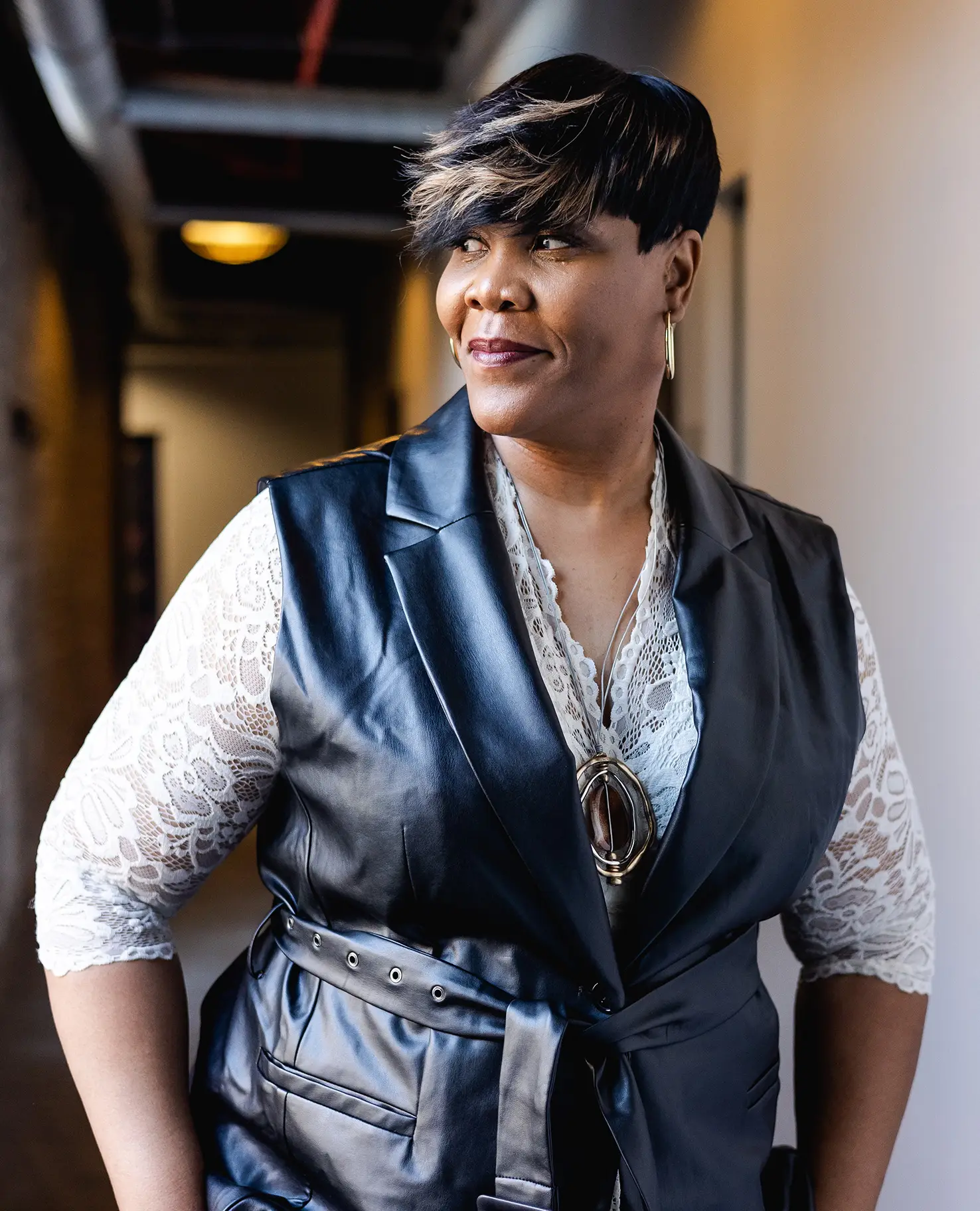
who is running it
Anita "AC" Clinton
Online Business Manager and Operations Integrator. AC builds and runs the back end for speakers, coaches, consultants, and mission-driven leaders through Front Stage, Back End and its flagship service, Back End Social.
Her background spans investment banking production, website design and management across six major platforms, large-scale email campaign coordination, and conference management. She has delivered the AI-Powered Marketing System session at the Polsky Center at the University of Chicago.
You stay on the front stage. I run the back end.
questions
Do I need to already use AI tools?
No, but you need one open and logged in when we start. If you have generated a single image before, you are fine. This is not a tour of the software.
Which image tool do you use in the workshop?
Whichever one you already use. What you build is a specification, and it works the same way in any of them. That is the point of building it rather than learning a tool.
Will this be recorded?
No, we will not have a replay for this webinar. Sessions run twice a month and you are more than welcome to come back.
Is this a pitch?
There is a pitch at the end, and it runs about eight minutes. I will announce it before it starts, so you can decide whether you want to remain. The first forty-five minutes teach the whole method, and you can use all of it without buying anything.
How many people are in the room?
Small enough that you can unmute and read something out. It is built to be worked through, not watched.
Will this work for my industry?
The mechanism does not care what you sell. The specification you build is yours, and two people in the same industry will leave with different ones.
I already work with a designer. Is this still useful?
Probably more useful. A specification is the thing you hand a designer so they stop guessing, and it is the thing that keeps your own quick posts looking like their work.
Pick Your Date...
First Saturday at 10:00 AM Central. Third Wednesday at 7:00 PM Central. Same workshop, two times, so one of them fits.