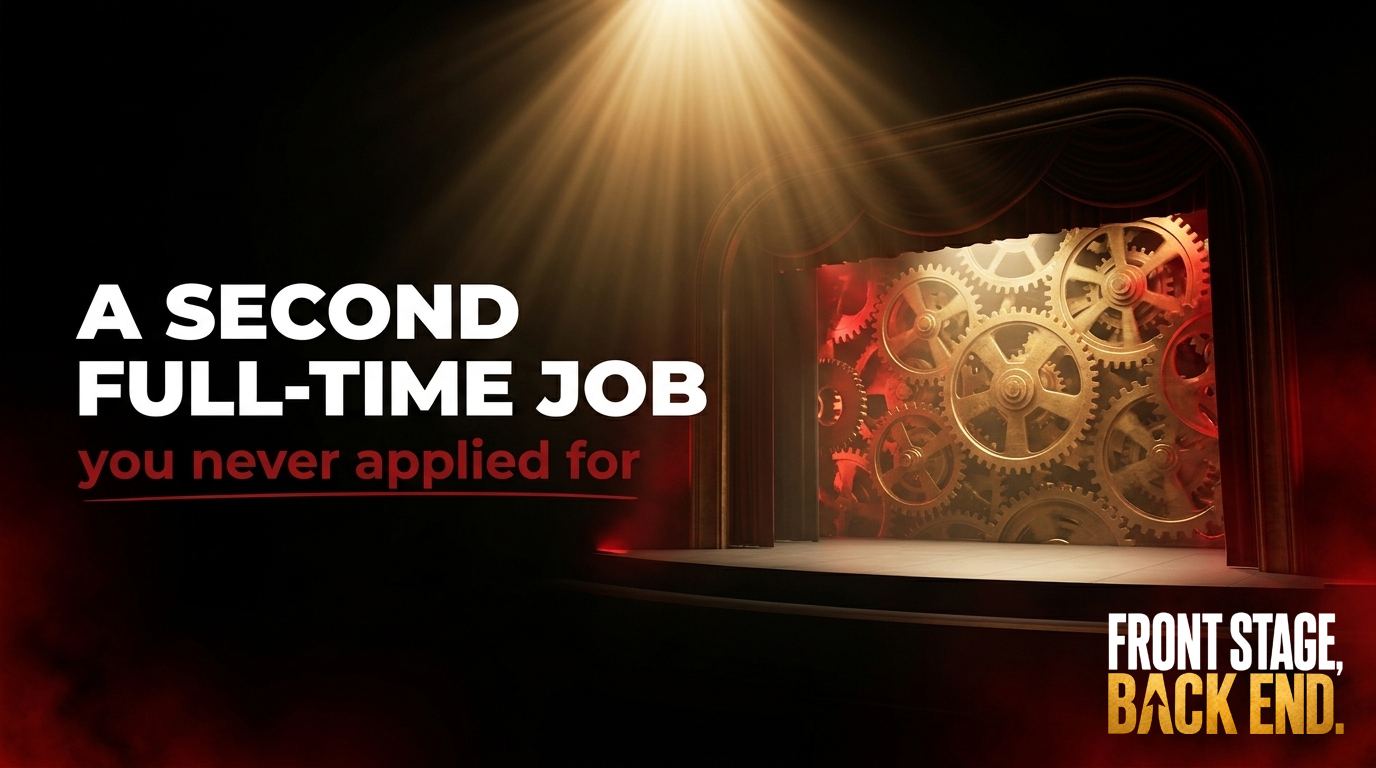

You did not hire yourself to run an operations department, and you did not sign up for the founder bottleneck that came with it.
You hired yourself to be the expert. The speaker, the coach, the consultant, the author, the agent, the leader people follow because of what you do when the room is watching.
Somewhere in the last two years the job description changed, and nobody sent the memo.
Now a meaningful share of your week goes to scheduling, platform settings, page edits, chasing an invoice, fixing an automation that broke quietly, and answering questions only you can answer because only you know how any of it was built.
That is not growth. That is a role you drifted into and never agreed to.
Here is the test, and it is short.
Think about the last time you were out for four days. Not a working trip. Actually out.
What kept running, and what waited for you?
If the honest answer is that most of it waited, you do not have a time problem. You have a structural one, and it has a specific shape: every decision in the business has to pass through the one person who is also the product.
I call it The Founder Bottleneck. You cannot out-discipline it, because it is not a discipline problem. It is a design problem, and it was designed by accident, one reasonable decision at a time.
You can hear it in the sentences people say right before they call me.
Nothing happens in my business unless I do it.
I cannot take a real vacation, the whole thing would fall apart.
I have five tools and none of them talk to each other.
Every launch feels like starting over.
I know I need help, but explaining it would take longer than just doing it.
That last one is the trap. It is true on any given Tuesday. It is false over a quarter. The cost of explaining it once is finite. The cost of never explaining it is every Tuesday you have left.
Why this happens to good operators specifically.
This is not a story about disorganized people. It happens most often to the ones who are exceptionally capable, and the reason is uncomfortable.
You are fast. You have built every part of this yourself, so you know exactly how each piece works. When something needs doing, you can do it in eleven minutes, and handing it off would take forty. So you do it, and you are right to, in that moment.
Repeat that decision a few hundred times and you have built a business that only functions with you inside it, which is precisely the business you cannot sell, cannot step away from, and cannot scale.
Competence is what got you here. It is also what is holding the ceiling in place.
What actually changes it.
Not more tasks assigned. Assigning tasks does not remove the bottleneck. It relocates it. You still hold the plan, still answer the questions, still approve every move. That is a manager’s workload wearing a delegation costume, and it is why so many people conclude that help does not work for them.
What changes it is handing off a function. Whole areas owned end to end by someone who takes responsibility for the outcome, not the errand. Operations. Funnels and launches. Content. Automation. Branding. Events. The work stops waiting for you because someone else owns whether it happens.
That is the difference between an assistant and an integrator, and it is the entire difference.
One honest caveat.
Handing off a function is not free and it is not instant. There is a period, usually the first thirty days, where it costs you more time than doing it yourself. That is the part people quit during.
What is on the other side is narrower and more valuable than the promise you usually hear. Your business stops being a referendum on your energy. The busy month does not become the silent month. You get to spend your best hours on the work only you can do, which is the work you actually built this to do.
Next week I will lay out exactly what I run, area by area, so you can see which part of your operation is the one that is breaking.
You stay on the front stage. I run the back end. See everything I run at anitaclinton.com/services.